How is AI already impacting aviation and what does the future hold?

What do we mean by ‘AI in aviation’?
Artificial intelligence (AI) in aviation is the use of machine learning, predictive analytics and automation to turn quality data, from flight sensors and maintenance logs to weather and passenger flows, into better decisions. Unlike traditional software, AI systems improve as they ingest more quality data, helping airlines, airports and OEMs to anticipate issues, optimise operations and reduce waste.
CO2 levels are slightly above normal in the cockpit ahead of boarding, a hydraulic pressure fluctuation occurs on a flap during takeoff, an engine vibration pattern crosses a learned threshold during the flight and the fuel burn is trending 2% higher than normal.
None of these fluctuations are obvious to the human eye – either to the cabin crew, the pilots or even maintenance, repair or overhaul (MRO) technicians. But they all suggest that parts of the aircraft are not performing optimally.
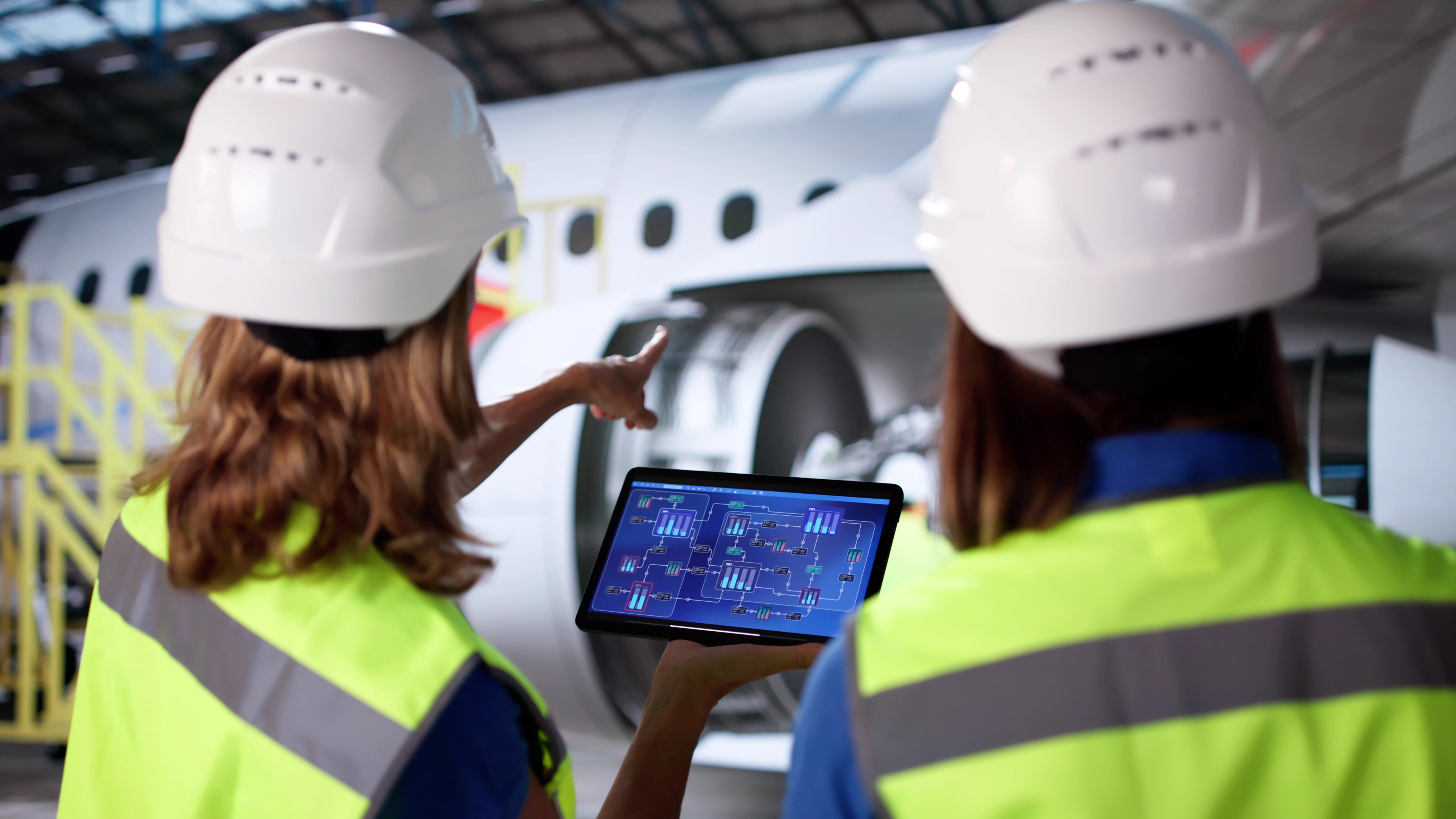
Across line, hangar and shop checks, the use of AI in aircraft maintenance flags the irregularities and schedules a repair or overhaul at a conveniently scheduled time that will minimise disruption.
This is how AI is quietly and incrementally impacting commercial aviation: ensuring fleets stay safe, reliable and efficient.
Current applications of AI in aviation
Today, AI in aviation is already delivering measurable impact across four core use cases:
Predictive maintenance
Air traffic control
Passenger experience
Operational efficiency
Predictive maintenance
The more quality data AI receives from the components of an aircraft , such as the engine, Environmental Control System (ECS), avionics etc., the better it can understand what ‘normal’ looks like.
Based on historical datasets, AI makes a note of every relevant deviation from the norm, particularly if it develops into a fault. Behind every one of its flagged irregularities is the experience of thousands of flights. Not every deviation holds the same urgency; alerts are tiered according to the likely seriousness.
Planners convert these alerts into work-scopes, align parts and slots, and avoid aircraft on ground (AOG) events. Not only are AOG events costly, but they are also highly disruptive to schedules and staff allocations.
Air Traffic Control
Imagine a view of the airspace that can predict the next hour, not just the next minute. Increasingly, AI-powered traffic-flow predictions, runway sequence optimisation and weather rerouting are enabling air traffic controllers and flow managers to see just that.
Meanwhile, airport operations teams on the ground are using AI to balance gate assignments, turnarounds and deicing queues so that bottlenecks don’t cascade into delays.
Simply by analysing a live video feed, AI-powered tech can detect 70 key milestones across 30 of the turnaround's sub-processes, flagging when any are behind schedule.
Passenger experience
AI is also transforming the passenger experience inside the departure hall, most notably by powering biometric identity checks that can shorten lines at security screening, passport control and the gate. AI chatbots are being used to assist with bookings and re-bookings.
Passengers increasingly want better digital engagement on their journeys, and AI-powered features are updating passengers of changes as they happen: departure time, weather conditions, imminent arrival of their luggage on the carousel, and so on.
This is good news for the shops and restaurants in the departure hall, as AI-powered engagement can target passengers with offers that feel relevant, rather than spammy.
This level of personalisation can continue on board with in-flight food and entertainment recommendations, which further raise satisfaction.
Operational efficiency
On the flight itself, AI models help to optimise fuel consumption and route planning.
The models simulate wind behaviour, temperatures, and traffic constraints to propose plans that cut fuel burn and avoid turbulence, or even contrails, where feasible.
Crew rostering algorithms factor in qualifications, duty limits, and preferences. During irregular operations, AI can suggest alterations that keep aircraft and people moving with the fewest cancellations.
What’s next for AI in aviation?
The future of AI in aviation will experience huge growth, but it won't be showy in the short-term.
Aviation is one of the most safety-critical industries in the world. Any AI tools that influence flight or ATC decisions require certification (for example, EASA/FAA) and robust safety cases, so deployments remain tightly scoped and continuously monitored.
It's important that there is always a human or two in the loop. Ultimately, AI analyses data, explains its findings and makes recommendations, but only qualified professionals can make decisions and draw on their experience and expertise to question, challenge, or even override the recommendations if necessary.
It's unlikely that this will change anytime soon.
In the near future of AI in aviation, the industry can expect steady, incremental progress, but nothing spectacular like a dramatic leap toward autonomy.
Instead, AI will continue to make aviation safer, more efficient and more sustainable by enhancing human expertise – not replacing it.
Progress will most likely be seen in AI in aviation in the following areas:
Air traffic control
MRO
Pilot support
Sustainability
Air traffic control
In the area of ATC, AI systems are increasingly being tested to handle routine tasks such as flight sequencing, traffic flow optimisation and conflict detection.
By automating repetitive processes, AI frees up human controllers to focus on complex or unusual cases that require judgment and quick decision-making.
This ‘manage by exception’ model balances efficiency with safety and ensures that human oversight remains central.
MRO
AI in aviation will continue to make advances using predictive analytics to streamline the full life-cycle of aircraft maintenance.
Predictive analytics can generate early alerts about potential component issues, which can then feed directly into digital work-scopes, parts inventory planning and slot booking – which helps to reduce delays, eliminate unnecessary handoffs and keep aircraft in service longer.
Over time, the integration of AI into MRO workflows could help airlines shift from reactive to proactive maintenance strategies.
Pilot support
Instead of replacing pilots altogether, AI in aviation will step on board as co-pilots providing a second pair of eyes in the cockpit.
This will enable the AI to monitor system performance, cross-check checklists and potentially detect and interpret in-flight anomalies.
By reducing the cognitive load of humans in the cockpit, these AI tools will enhance situational awareness, allowing pilots to dedicate more attention to decision-making and passenger safety.
Sustainability gains
AI also has a growing role to play in aviation’s sustainability journey.
Smarter flight planning can help to optimise routes and climb profiles, reducing fuel burn and even limiting the production of contrails, which can often form clouds that trap heat and cause short-term damage to the environment.
In line with efforts to reduce fuel burn, AI will help airlines to integrate effective sustainable aviation fuel (SAF) strategies into their operations for maximum efficiency and climate benefit.
SATAIR TAKEAWAY
Don’t expect anything too showy in the near future for AI in aviation. The technology is already travelling on a winning trajectory - across the industry, its effects are being felt acutely. Most notably, this is through the gains achieved by its predictive maintenance, smoother traffic flow management and on-time performance. The gains are huge: not only are operations safer, but the passenger experience is soaring and costs are decreasing. So for the time being, the industry can expect the steady improvements to continue, just as long as it keeps feeding the AI the right kind of data.